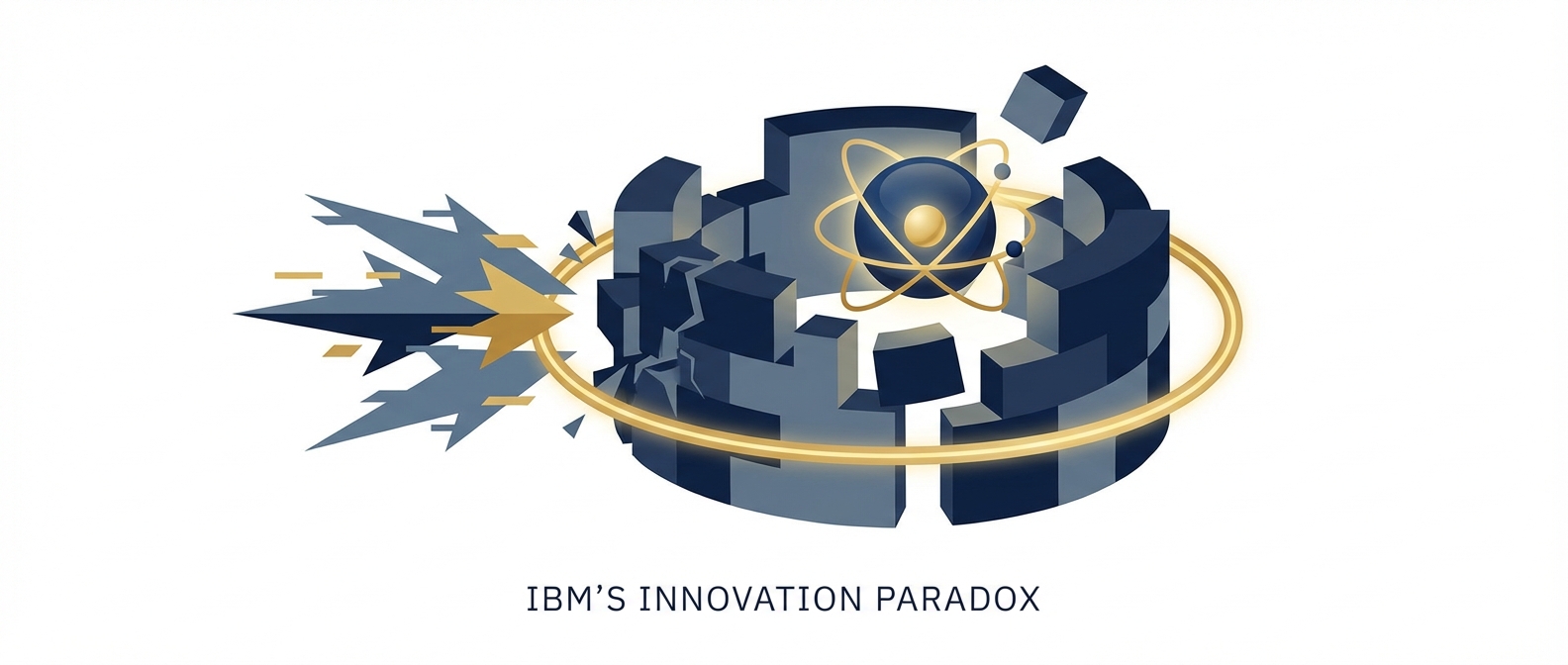
According to reporting from Various News Agencies, International Business Machines (IBM) is currently navigating a critical juncture as its stock faces volatility driven by emerging AI competitors targeting its legacy revenue streams. While the company accelerates its roadmap toward achieving “Quantum Advantage” by late 2026, sources indicate that the immediate market sentiment has been rattled by new automated coding tools that threaten the high-margin consulting business of modernizing legacy systems.
The Disruption of Legacy Consulting
Market analysis suggests that the recent downward pressure on IBM shares is largely attributed to the release of advanced AI coding assistants, specifically Anthropic’s “Claude Code.” Sources indicate this tool is designed to automate the modernization of COBOL—the decades-old programming language that underpins a vast majority of the financial and government systems IBM Consulting is paid to maintain and upgrade.
Revenue Impact: Legacy system modernization is a multi-billion dollar sector; AI automation could significantly compress the billable hours and contract values for firms like IBM, Accenture, and Cognizant.
Market Reaction: Trading data reveals a sharp sell-off in the sector as investors recalibrate the long-term value of human-centric IT consulting in an age of autonomous coding agents.
Macro Factors: According to reporting from Various News Agencies, broader tech sector headwinds, including new trade tariffs and policy uncertainties, have further compounded the stock’s recent volatility.
IBM’s Counter-Strategy: Quantum and Hybrid Cloud
Despite these near-term challenges, IBM remains aggressive in its deep-tech pivot. Sources indicate the company is on track to deliver “Quantum Advantage”—the point where quantum computers solve practical problems better than classical supercomputers—by the end of 2026. Furthermore, IBM’s semiconductor research continues to advance, with presentations at major industry conferences highlighting progress in 2nm chip manufacturing and High NA EUV processes.
Key Data Points
Quantum Roadmap: Targeting verifiable quantum utility in 2026.
Financial Health: The company maintains a robust dividend yield of approximately 2.6%, appealing to income-focused investors despite growth concerns.
Strategic Pivot: Increased focus on the watsonx enterprise AI platform to offset potential declines in legacy consulting revenues.
Frequently Asked Questions
Why is IBM stock experiencing volatility in February 2026?
According to market reports, the decline is driven by fears that new AI tools from competitors will automate COBOL code modernization, disrupting IBM’s lucrative consulting revenue, alongside broader macroeconomic trade concerns.
What is IBM’s major goal for 2026?
Sources indicate IBM is targeting the achievement of “Quantum Advantage” by the end of the year, aiming to prove its quantum systems can outperform classical computers in specific, high-value use cases.
Is IBM’s dividend safe?
Financial analysts note that IBM continues to generate strong free cash flow and has a long history of paying dividends, currently yielding around 2.6%, suggesting the payout remains stable despite share price fluctuations.







Leave a Reply